Targets your fullness signal
After you eat, your body releases GLP-1, a hormone that travels to your brain and signals fullness. Semaglutide mimics that signal.

Choose the path that fits you.
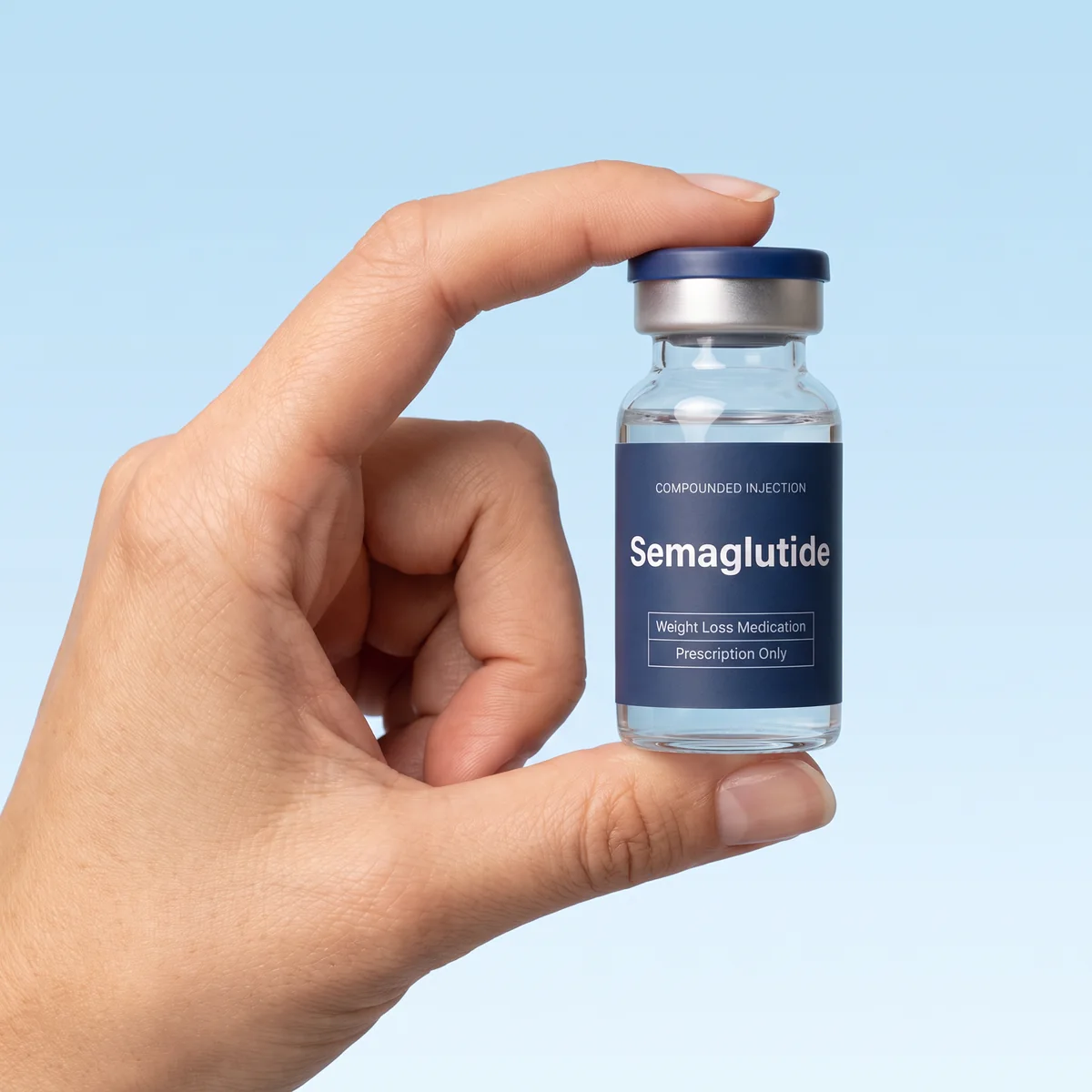 Compounded in the U.S.A.Rx only
Weekly GLP-1.
Provider-guided.
 Compounded in the U.S.A.

Once weekly.Provider-guided.
Illustrative image — not a CAPO Health patientIllustrative image; actual packaging may vary.
Compounded · GLP-1 injection
A once-weekly injection that works like GLP-1, a hormone your body already uses to regulate hunger — slowing how quickly food leaves your stomach and quieting appetite signals.
From $99/month equivalent
Description
Semaglutide works like GLP-1, a hormone your body releases after eating.
It signals fullness to your brain and slows how quickly your stomach empties, so smaller portions can feel like enough. Taken as a once-weekly injection under the skin, as part of a provider-guided plan with healthier eating and more activity.
Plans & pricing
Your plan
$99/month equivalent
Same price at every prescribed dose.
Choose your plan
HSA/FSA cards accepted · No insurance required


 On 3-, 6- and 12-month plans, at checkout. Subject to eligibility.
No subscription required · cancel anytime from your account · no cancellation fee.
Choose Semaglutide · 12-month plan → Questions? Call 1-833-772-7117No enrollment, consultation or membership fees. If treatment isn't right for you, you're refunded in full.
Dosing
Reference only
A provider may hold, adjust or stop a step based on your history, your response and how you tolerate it.
| Period | Reference dose | Phase |
|---|---|---|
| Weeks 1–4 | 0.25 mg weekly | Starting dose |
| Weeks 5–8 | 0.5 mg weekly | Titration |
| Weeks 9–12 | 1 mg weekly | Titration |
| Weeks 13–16 | 1.7 mg weekly | Titration |
| Week 17 onward | 2.4 mg weekly | Maintenance may be lower |
This table summarizes the titration schedule published in the prescribing information of the approved reference product. Compounded preparations are not FDA-approved, and compounded concentrations and schedules can differ. It is not a prescription and not instructions to adjust your own dose. Use only the dose and the measuring instructions on your pharmacy label, and talk to your provider before any change.
Reference: the dosage section of the prescribing information for the approved reference product containing semaglutide.
Prescription only. Important Safety Information
After you eat, your body releases GLP-1, a hormone that travels to your brain and signals fullness. Semaglutide mimics that signal.
Food leaves your stomach more gradually after a meal, so fullness lasts longer and hunger returns more slowly.
GLP-1 also takes part in how your body handles blood sugar after eating, so the sharp spikes and crashes that often send you looking for food are steadier.
Provider consultation, medication and supplies, shipping and your patient portal — in every plan.
A licensed provider reviews your short intake and follows up through your portal. No separate consultation fee.
Your prescribed medication and the injection supplies that go with it.
Shipped to your door by our partner pharmacy, with tracking sent by email.
No separate enrollment, consultation or membership fees. Your plan price is the price.
Messages with your care team, refill requests and order tracking, HIPAA-secure.
If the provider decides treatment is not appropriate, nothing is dispensed and your order is refunded in full.



 HSA / FSAHSA/FSA cards accepted · No insurance required. Payment is collected at checkout. HSA/FSA eligibility depends on your plan administrator.On 3-, 6- and 12-month plans, at checkout. Subject to eligibility.
Features and services are subject to availability and eligibility. Portal preview is illustrative.
Start my online visit →Potential benefits
Semaglutide works like GLP-1, a hormone your body already uses to manage appetite and blood sugar after you eat. As part of a provider-guided plan with healthier eating and more activity, it may help you:
Quiet constant thoughts about food, so healthier choices feel easier.
Feel satisfied with smaller portions, for longer.
Work toward weight loss at a gradual pace your provider sets. No crash dieting.
GLP-1 helps your body release insulin when blood sugar rises after a meal.
Your care team helps you manage common effects like nausea.
Your provider checks in and adjusts your dose as your body responds.
Individual results vary. Benefits are not guaranteed and depend on your provider's evaluation and your plan.
Why it matters
It's not just willpower. Hunger hormones, metabolism and genetics push back when you try to lose weight, and excess weight affects much more than how you feel.
A licensed provider reviews your short online form and decides whether a GLP-1 medication is right for you.
What does it do
Your formulation
Compounded semaglutide, prepared with one supporting ingredient — vitamin B12 or glycine. Your provider chooses the formulation that fits your file.
The active medication: a GLP-1 receptor agonist, taken once a week.
An amino acid your body uses to build protein. May support muscle maintenance while you eat less.
A vitamin involved in energy metabolism and red blood cell formation. May help maintain nutrient balance while you eat less.
Your provider determines the formulation, strength and directions that are appropriate for you. Personalized options are not guaranteed.
From first question to follow-up
Complete a short online form about your goals and the medicines you take — it takes a few minutes — then choose a plan and check out.
A provider licensed in your state reviews your form and decides whether treatment is appropriate. If it is not, your order is refunded in full.
If prescribed, your medication is compounded by a state-licensed pharmacy and shipped to you. Check-ins continue through your portal.
Understanding your options
Compounded semaglutide is one option among several. Your provider weighs your medical history, your other medications and your goals before recommending it, a different medication or no treatment at all.
Also exploring your options? Learn about Compounded Tirzepatide
Compounded treatment is meant for cases where an FDA-approved medicine cannot meet a patient's medical needs, as determined by the provider.
Your prescription and your measuring instructions are specific to you. Your care team reviews how you respond and answers questions along the way.
Screening tool
BMI uses your height and weight to estimate whether your weight falls within a healthy range for your height — one of the first things a provider looks at before considering semaglutide.
Your BMI
Enter your height and weight to see your result.
*BMI does not directly measure body fat and may not accurately reflect health for people with high muscle mass, pregnant women, children, older adults and some ethnic groups. It is a screening tool, not a diagnosis, and it does not determine eligibility. Providers generally consider GLP-1 therapy for adults with a BMI of 30 or more, or 27 or more with a weight-related condition.
Pharmacy & compliance
If a provider prescribes treatment, your medication is prepared by a state-licensed compounding pharmacy operating under Section 503A of the Federal Food, Drug, and Cosmetic Act, and shipped to your door.
Our partner pharmacy is The Pharmacy Hub (Miami, FL). CAPO Health is not a pharmacy and does not compound, manufacture or dispense medications. Availability of certain medications or formulations can vary by state.

Illustrative image
Before you begin
A little clarity goes a long way.
No. Compounded semaglutide is prepared by a U.S. state-licensed pharmacy for an individual patient under a provider's prescription. The FDA does not review or approve compounded drugs for safety, effectiveness or quality, and compounded semaglutide is not a generic of, or equivalent to, any branded medication.
Usually not. Providers start low and increase gradually, because most side effects appear when starting or raising the dose. If you are switching from another provider, share your current medication and dose in the intake — your provider takes it into account.
Nausea, diarrhea, vomiting, constipation, stomach pain, headache and tiredness are the most common, mostly when starting or increasing the dose. Serious side effects are rare but possible — read the Important Safety Information on this page before starting.
Semaglutide acts on one hormone receptor (GLP-1); tirzepatide acts on two hormone receptors (GIP and GLP-1). Your provider recommends one, or neither, based on your health history, goals and any medication you already take.
If the licensed provider decides that treatment is not appropriate for you, you are notified with the reason and no medication is dispensed. Any amount you have already paid is refunded in full to your original payment method. Not everyone qualifies, and the provider may recommend a different path.
Compounded semaglutide is not approved by the FDA, and the FDA does not review it for safety, effectiveness or quality. Nausea, vomiting, diarrhea, constipation and abdominal discomfort can occur, most often when starting or raising a dose.
Serious risks include pancreatitis, gallbladder disease, dehydration-related kidney injury, changes in vision and severe allergic reactions. Approved semaglutide labeling carries a boxed warning about thyroid C-cell tumors based on animal studies; the risk in humans is unknown. Do not use with a personal or family history of medullary thyroid carcinoma or MEN 2.
Review every medicine you take and any pregnancy plans with your provider, including insulin, sulfonylureas and oral contraceptives. Seek urgent care for severe abdominal pain or trouble breathing. Read the full safety information below.

The online visit takes just a few minutes. If a licensed provider decides treatment isn't right for you, nothing is dispensed and you're refunded in full.
Questions? Call us at 1-833-772-7117
Important Safety Information
Compounded semaglutide is prepared for an individual patient by a U.S. pharmacy licensed in the state where it dispenses, under a prescription from a licensed provider. Federal law permits compounded drugs to be prescribed, but they are not FDA-approved, and the FDA does not review them for safety, effectiveness or manufacturing quality. Compounded semaglutide is not a generic version of, or equivalent to, any branded medication. Prescription required. Not everyone qualifies. Individual results vary.
In rodent studies, semaglutide caused thyroid C-cell tumors. It is not known whether semaglutide causes thyroid C-cell tumors, including medullary thyroid carcinoma (MTC), in people. Do not use semaglutide if you or a family member has ever had MTC, or if you have Multiple Endocrine Neoplasia syndrome type 2 (MEN 2). Tell your provider right away if you notice a lump or swelling in your neck, hoarseness, trouble swallowing or shortness of breath.
Semaglutide is a glucagon-like peptide-1 (GLP-1) receptor agonist. When prescribed for weight management it is used together with a reduced-calorie diet and increased physical activity in adults with obesity, or with overweight and at least one weight-related medical condition. Whether it is appropriate for you is decided by your licensed provider after reviewing your health history. It has not been studied in combination with other GLP-1 medicines and is not for people with type 1 diabetes.
Once a week, on the same day each week, as a subcutaneous injection under the skin of the abdomen, thigh or upper arm. Your provider starts at a low dose and increases it gradually according to how you tolerate it. Use a new needle for every injection and never share vials or needles.
Semaglutide should not be used during pregnancy and may harm an unborn baby. If you plan to become pregnant, stop semaglutide at least two months beforehand, as it stays in the body for a long time. It is not known whether semaglutide passes into breast milk; discuss feeding options with your provider.
Nausea, diarrhea, vomiting, constipation, stomach pain, headache, tiredness, upset stomach, dizziness, bloating, belching, gas, stomach flu, heartburn and reactions at the injection site. Digestive symptoms are most common when starting or increasing the dose and often ease over time. This is not a complete list.
This summary does not replace the full prescribing information and is not medical advice. Discuss every risk and benefit with your licensed provider before starting or changing treatment. If you experience a serious side effect, contact your provider; in an emergency, call 911. Suspected adverse reactions can also be reported to the FDA at 1-800-FDA-1088 or www.fda.gov/medwatch. Individual results vary.
Compounded Semaglutide is compounded by a state-licensed pharmacy under Section 503A of the Federal Food, Drug, and Cosmetic Act and is dispensed only with a patient-specific prescription issued after a medical evaluation. It is not approved by the FDA and is not a generic version of, or equivalent to, any branded medication. Pricing shown on this page reflects current plan prices; your provider confirms your plan and final price after review, and if no prescription is issued your order is refunded in full. Individual results vary.
The FDA does not review compounded medications for safety, effectiveness or quality, and treatment requires an individual evaluation and a prescription. CAPO Health is not a pharmacy: if prescribed, your medication is prepared by a state-licensed compounding pharmacy and your pharmacy label shows the concentration and directions prescribed for you.
CAPO Health is a technology platform. CAPO Health is not a pharmacy and does not practice medicine. Medical services are provided by independent, state-licensed healthcare providers who exercise their own clinical judgment. Prescription only if a licensed provider determines it is clinically appropriate. Not everyone qualifies, and no treatment, outcome or eligibility is guaranteed.
Most medications referenced on this site are compounded preparations prepared by U.S. pharmacies licensed in the state where they dispense. Compounded drugs are not approved by the FDA and are not evaluated by the FDA for safety, effectiveness or quality. They are not generic versions of, or equivalent to, any branded medication. Some medications, such as oral tablets, may be dispensed as commercially manufactured products; your pharmacy label shows what was dispensed. Clinical evidence for wellness uses of NAD+, Lipo-B and glutathione is limited.
GLP-1 receptor agonists carry risks, including but not limited to nausea, vomiting, diarrhea, constipation, pancreatitis, gallbladder disease and, in animal studies, thyroid C-cell tumors. Discuss your full medical history, including any personal or family history of medullary thyroid carcinoma or MEN 2, with your provider. Every other treatment carries its own risks: PDE5 inhibitors must never be combined with nitrates. Read the Important Safety Information on each treatment page. This website does not provide medical advice and is not a substitute for consultation with a qualified clinician. In an emergency, call 911.
Weight figures, timelines and projections shown anywhere on this page are illustrative and drawn from published clinical literature, not from CAPO Health patient outcomes. Individual results vary. Your provider confirms the plan after review; if no prescription is issued, any amount paid is refunded in full. Product-specific risks, contraindications and side effects are listed in the Important Safety Information for each medication, available from every treatment card and from the footer. This site collects no protected health information — intake happens inside the secure, HIPAA-compliant patient portal.
People pictured on this site are illustrative images, not CAPO Health patients. They do not describe anyone's treatment experience and do not depict the results of any medication. Individual results vary.